Our Science
Fibrosis – the accumulation of scar tissue
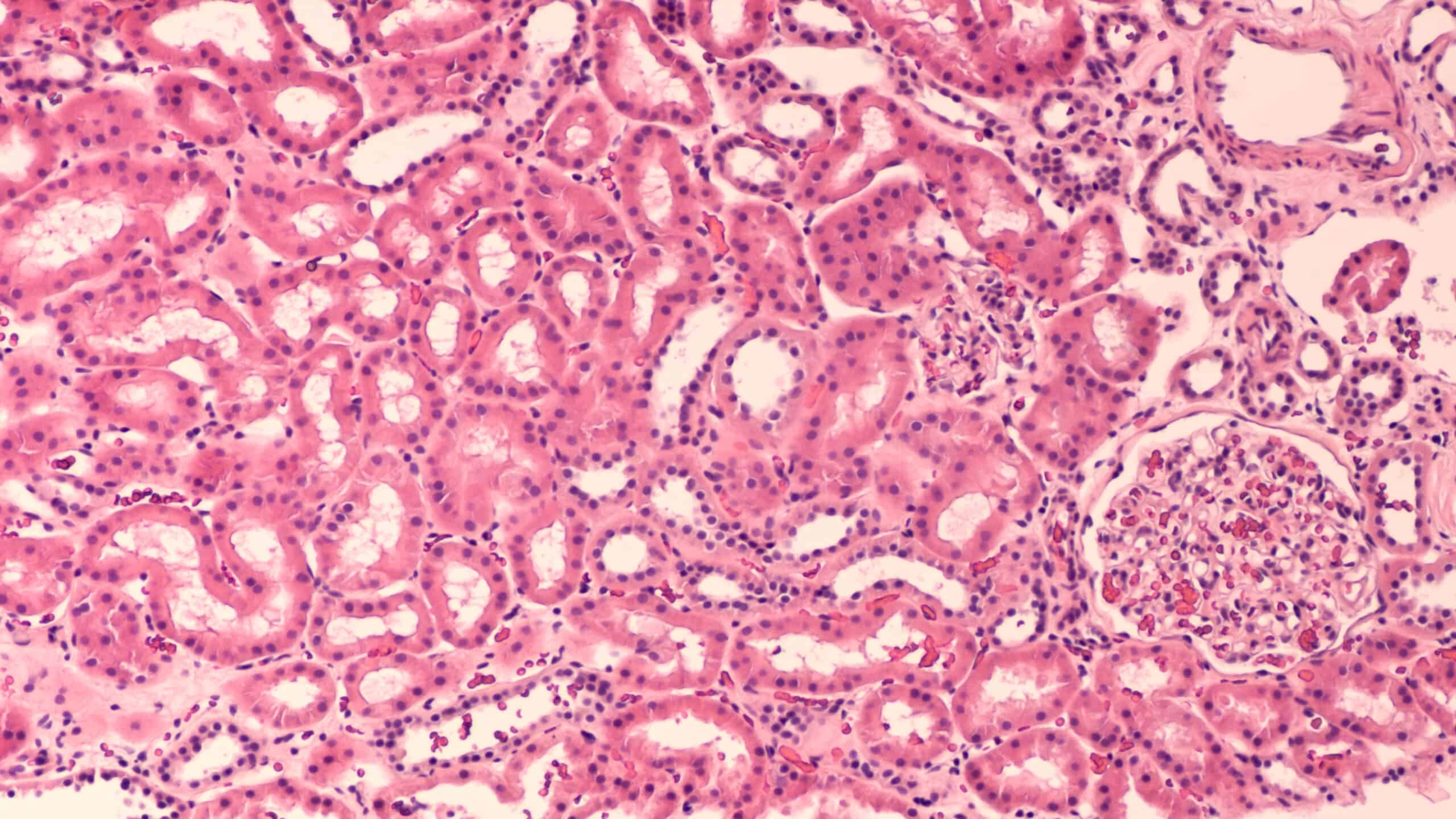
Fibrosis is defined as the pathological deposition of excess extracellular matrix, for example, collagen, in injured or diseased tissue. It results from cellular damage that triggers recruitment of inflammatory cells that secrete cytokines such as transforming growth factor-beta (TGF-β) that, in a complex cascade of events, lead to the excess collagen and extracellular matrix. It can affect any tissue or organ, and the US government estimates that 45% of deaths in the USA can be attributed to fibrotic disorders. It is clearly an area of high unmet medical need.

The fibrotic process and role of integrins
From the family of 24 integrins found in vertebrates, a subset of eight are Arg-Gly-Asp (RGD) integrins. The av-sub family includes αvβ1, αvβ3, αvβb5, αvβ6, αvβ8 and α5β1 integrins that recognise an RGD-sequence in the latency associated peptide (LAP) that maintains TGF-β in an inactive form. The integrin binds to the RGD-sequence on LAP causing release of TGF-β that leads to the deposition of extracellular matrix and hence fibrosis. Whilst direct inhibition of TGF-β has been associated with undesired side-effects, TGF-β levels can be modulated by inhibition of specific integrins, preventing their binding to the LAP, and hence release of TGF-β, which makes the selective inhibition of RGD-integrins an attractive therapeutic strategy.
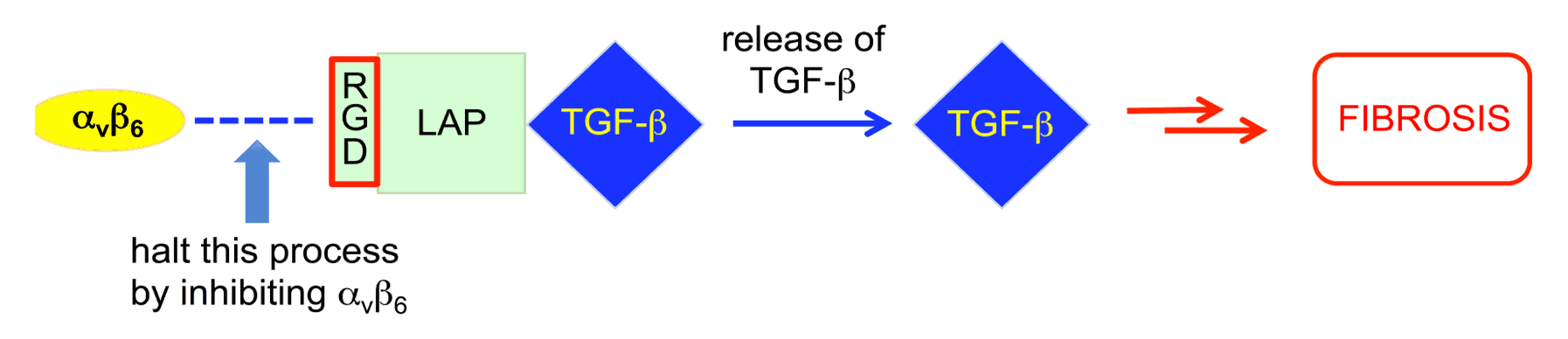
Our approach to the inhibition of RGD-integrins is to mimic the RGD sequence in the LAP binding site by designing molecules with a basic site, a linker and an acid group to mimic the arginine, glycine and aspartic acid residues respectively. The result is the design and synthesis of a substantial library of more than 600 novel, small molecule RGD-integrin inhibitors in several chemical series, with nanomolar in vitro potency (cell adhesion assay) and drug-like physicochemical properties for suitable for inhaled, oral or intravenous administration.
We aim to develop our preclinical and discovery-stage assets towards clinical application, to offer new treatments and relief for millions of patients affected by life-limiting conditions for which no effective therapy currently exists.

Therapeutic applications
The elevated expression of the RGD-integrins in fibrotic tissue compared to healthy tissue, supports their status as therapeutic targets. Our priorities are to develop Alevin’s pipeline of potent and selective integrin antagonists to address unmet medical needs such as kidney disease and cancer, including integrin-targeted radiotherapy approaches.
There is good evidence for integrin involvement in kidney disease, and proof of concept attained with pan integrin inhibitor MK-0429 – decreased proteinuria and renal fibrosis in animal models. A FDA/EMA Fast Track and Orphan Drug designation offers an opportunity for an integrin inhibitor, since no antifibrotic therapies approved to date.
About 2 million deaths annually (1 in 25 of all deaths worldwide) are due to liver disease, with the global market for treatment projected to reach almost USD 70 Bn by 2030.
Literature supports the involvement of integrins in liver fibrosis with both αvβ1 and αvβ6 inhibitors showing efficacy in animal models of liver fibrosis. A dual αvβ1/αvβ6 inhibitor is currently in the clinic for primary sclerosing cholangitis (PSC), a rare but chronic liver condition.
The involvement of integrins in cancer progression is well established, and gene expression data for αvβ1, αvβ3, αvβ5, αvβ6, αvβ8 and α5β1 integrins are available for over 300 different cancer cell lines. Therefore, in principle, can select integrin(s) to target for a given tumour cell type.
There is good evidence for integrin involvement in a range of cancers, and a recently completed in vitro screen of ca. 40 Alevin compounds against 8 human cancer cell lines has identified the most sensitive lines.
As cell surface receptors, integrins are ideal targets for drug delivery approaches. Hence can use small molecule, selective RGD-integrin binders to deliver a radionuclide to a tumour cell in targeted radiotherapy. On binding to the RGD-receptor, the inhibitor molecules internalise into the cell – a significant advantage. The approach has been validated in vivo in glioblastoma using an 225Ac α-emitter linked to a RGD-mimic targeting the αvβ3 integrin.
Alevin has a substantial library of small molecule αv integrin inhibitors with varying selectivity for the integrin isoforms. We have shown that a linker chain with potential to carry a radionuclide can be incorporated into an inhibitor without significant loss of potency. This represents a significant development opportunity – the global nuclear medicine market was USD 7.9 Bn in 2024 and forecast to rise to USD 17.7 Bn by 2033 with a CAGR of ~11%, with a significant proportion of this market devoted to targeted delivery approaches.
Highlights from the Scientific Founders’ Publications
Indolequinone inhibitors of NRH:quinone oxidoreductase 2. Further structure-activity relationships. T. A. Dias, D. Siegel, D. Ross and C. J. Moody, Bioorganic and Medicinal Chemistry, 2026.
Basement membrane repair response biomarker PRO-C4 predicts progression in idiopathic pulmonary fibrosis: analysis of the PFBIO and PROFILE cohorts. J. M. B. Sand, P. Frederiksen, A. E. John, F. B. Simoes, N. Hoyer, T. S. Prior, A. Avdic-Belltheus, P. L. Molyneaux, I. D. Stewart, H. P. Fainberg, S. R. Johnson, M. A. Karsdal, D. J. Leeming, E. Bendstrup, S. B. Shaker, T. M. Maher, G. Jenkins, Thorax, 2025.
Geldanamycin, a naturally occurring inhibitor of Hsp90, and a lead compound for medicinal chemistry. R. R. A. Kitson, D. Kitsonová, D. Siegel, D. Ross and C. J. Moody, Journal of Medicinal Chemistry, 2024.
AKAP13 Expression and Its Implications. B. Liu, E. Pyman, A. Vairon, M. Zarcone, E. L. L. Jimenez, R. G. Jenkins, A. E. John, American Journal of Respiratory and Critical Care Medicine, 2024.
Defining the mechanism of galectin-3-mediated TGF-b1 activation and its role in lung fibrosis. J. F. Calver, N. R. Parmar, G. Harris, R. M. Lithgo, P. Stylianou, F. R. Zetterberg, B. Gooptu, A. C. Mackinnon, S. B. Carr, L. A. Borthwick, D. J. Scott, L. D. Stewart, I. D. Stewart, R. J. Slack, R. G. Jenkins, A. E. John, Journal of Biological Chemistry, 2024.
Discovery of new imidazotetrazinones with potential to overcome tumor resistance. H. S. Summers, W. Lewis, H. E. L. Williams, T. D. Bradshaw, C. J. Moody and M. F. G. Stevens, European Journal of Medicinal Chemistry, 2023.
For an expanded list of relevant publications from the Scientific Founders, please click here.